Showing posts with label Iraq War. Show all posts

9/14/2010

Roy Hattersley on Blair's Little Book

The strength of conviction is not matched by clarity of expression. Blair writes that he "can't regret the decision to go to war". That is clear enough, but he extends the assertion with pure gobbledegook:
    I can say that I never did guess the nightmare that unfolded and that too is part of the responsibility. But the notion of responsibility indicates not a burden to discharge but a burden that continues. Regret can seem bound to the past. Responsibility has its present and future tense.
Whatever that means, he goes on to explain the necessity to topple Saddam Hussein with an argument that is undeniably intelligible. It amounts to an inventory of slaughter - on one side of the balance sheet, the Iraqis who died during, and in consequence of, the war and, on the other side, the killings of which Saddam was guilty. Naturally, he chooses the figures most favourable to his argument. The Lancet estimate that the war was responsible for 600,000 deaths (and only up to 2004, though the book does not say so) is brushed aside. But the dubious use of statistics is less revealing than the belief that the table of relative attrition is some sort of vindication of a war which, we were told, was fought to rid the world of Saddam's weapons of mass destruction.
Strangely, the account of a journey that made a diversion through Rome never mentions the Roman Catholic Church. Blair, however, is wise not to measure his decision to invade Iraq against the papal definition of a just war. Just wars must have the prospect of a successful outcome. The best he can offer by way of an assurance of success is the repetition of Zhou Enlai's judgement on the significance of the French Revolution: "It is too early to say." But one thing is clear: whether the call to battle came from God or from George W Bush, Blair answered without the slightest doubt about the justice of the cause and with little regard for either his personal popularity or his electoral prospects - the two considerations that his more simplistic critics claim are his principal preoccupation. A Journey dispels the myth that Blair had no strong beliefs. On the contrary, his weakness was too little doubt.
From the moment he became Labour leader, Blair was determined to re-create the party in his image - eager to alleviate suffering and reduce injustice, but wholly opposed to making any fundamental change in the way society is arranged. And he was convinced that he, as well as those around him, could transform his decent instinct into a new theory of government.
Even now, Blair maintains total confidence in the ragbag of ideas that was the New Labour prescription. His faith in the market remains absolute and he dismisses the banks' collapse as "the failure of one sector", not an inherent weakness in the system of "light-touch regulation". He also argues in favour of direct taxes being held at "a competitive" rate while the necessary revenue is raised by an increase in VAT. Gordon Brown's decision to "ditch" the Manchester super-casino - the quick fix to the city's unemployment problem - was "a real shame". All these notions are advanced as if men and women of sound judgement and good intentions accept them as self-evident truths. Yet he admits that, by the end of his premiership, only John Reid and Tessa Jowell were still true believers. If that does not shake his faith in the Third Way, nothing will.
Ideological discussion bores him and he confuses principle with prejudice. That is why, at first, the ideas that guided his domestic policies seemed to be united by only one common theme - their popularity among the "target voters" who secured him three consecutive election victories. That objective was, I wrongly believed, what determined his reaction to the furore which followed the discovery that Harriet Harman had sent her son to a grammar school far outside the catchment area in which the family lived.
His first impulse, he tells us, was to sympathise - one parent to another - with Harman's determination to do the best for her child. Then he moved on to what he still regards as the overriding reason for the Labour Party not making public the anger that so many of its members (including most of Blair's aides) felt. "Before we know where we are, we've really unsettled sensible middle-class opinion." That policy criterion is not as cynical as it first sounds. Blair's Summa Theologica was, and no doubt still is, built around the importance of following sensible, middle-class opinion. Compared to the war in Iraq, the "Harman affair" was a little local difficulty, but it revealed Blair's true system of values.
It was the discovery of how Blair had responded to that imbroglio which convinced me he was not the party leader I'd hoped for, but I should have realised my mistake much earlier. During his early years in parliament, we saw a great deal of each other. His first front-bench job was as the junior member of the opposition's Treasury team when I was shadow chancellor. When he was promoted to Labour's "City spokesman", he occasionally asked my opinion on small items of policy and performance.
On 13 June 1988, we talked about how he should respond to a government statement on an inquiry into the collapse of Barlow Clowes, a Gibraltar-based investment company which, despite a Department of Trade certificate of viability, had gone into liquidation. His response seemed fine to me, but I made the mistake of saying that I felt very little sympathy for the men and women who had lost their money; they had invested their savings "offshore" in order to avoid paying tax. Blair reacted with polite outrage. The victims were, he said, honest citizens doing their best for their families and he proposed to speak up for their laudable thrift. He had not even considered that people can, while acting within the law, betray their obligations to society.
The Barlow Clowes revelation did not prevent me from supporting Blair's candidature for the Labour leadership enthusiastically. He telephoned me on the Sunday after John Smith died and I told him he had my vote. He said - I believed him then and I believe him now - that although he had made up his mind, he was unhappy about pushing Brown aside: "Gordon has always wanted it much more than I do and wanted it for so long." In those days, Brown and Blair were David and Jonathan rather than Cain and Abel, and Brown was the senior partner in the relationship. During Neil Kinnock's leadership Blair came to see me, distraught at the Tribune Group's decision to include Brown, but not him, in its "slate" of recommended shadow cabinet candidates. He stood, nevertheless, and was elected. And even in the anguish of rejection by the Tribune Group, he still exhibited both admiration and affection for Brown. Yet A Journey is a sustained assault on his old friend's conduct and character.
The only plausible explanation for this is bitterness - bitterness about attempts to make him keep his promise to abdicate in 2002, bitterness at being deposed before he was ready to go and, most of all, bitterness about the obstruction of his most cherished policies. The index entry for Brown is a litany of objections, most of them to proposals that a wholeheartedly left-wing government would not have even contemplated: "Against Millennium Dome . . . Resists tuition fees . . . Opposes academies school programme . . ."
Blair could not be more frank in explaining why he remained so long and was so sure that his departure would end in disaster: "Only through holding to the New Labour course, with passionate not tactical engagement, could we hope to succeed. . . . But I'm afraid [Brown] couldn't see it."To reject New Labour was to reject Blair himself - not the leader of a political party, but a one-man crusade on a personal mission to make the world fit for the sensible middle classes to inhabit.
Though it is possible to explain why the book casts Brown as villain, parts of A Journey are simply inexplicable. What purports to be a serious account of political reform and inter national statesmanship is interrupted from time to time with accounts of the Blairs' physical relationship. The public comments on what should remain private matters are written in the style of cheap romantic fiction and it is so embarrassing to read them that their inclusion in the book raises grave questions about the author's judgement. Yet there are also parts of the book that remind the reader why he rose so high so quickly.
In February 2007, he "explained [to Brown] that there were only two ways that Labour could win the election. One was a decisive rupture with [his] time in office . . . That would require a new and credible agenda . . . The other was 'Continuity New Labour'." He wanted his successor to choose the second option. I longed for him to choose the first, but Blair was right to say that making the choice was essential. Unfortunately, Brown chose neither course, and so the Labour government ended in tragic irony. Blair, who never wanted Brown to become prime minister, described the path to victory. And, by rejecting his advice, Brown convinced Blair that he had been right to hope for a different successor.
Back in 1988, when John Prescott challenged me for the deputy leadership of the Labour Party, Kinnock organised a campaign to persuade me to accept a second stint in a job that I never wanted. Brown and Blair were persuaded to convince me that it was my duty to accept the nomination. They came into my room straight from a Monday-night meeting of the Tribune Group and announced that a motion supporting my candidature had just been carried. We then enacted a version of an ancient political joke. What, I asked, like the dying MP whose constituents had voted on a message of condolence, was the result? Brown answered with the hackneyed punchline. "Ten in favour, seven against with six abstentions." But, Blair added, "most Tribune members will vote for you. Real ones, not just those of us who thought we had to join."
Morally speaking, Blair the charming zealot who was prime minister for ten years was a much better man than Blair the young MP on the make, who claimed to support unilateral nuclear disarmament, withdrawal from the European Union and the nationalisation of almost everything. But he was also much more dangerous. As things turned out, he became the embodiment of the dilemma that faces enthusiasts for conviction politics: what if the convictions lead to behaviour that more measured judgement would have rejected? The catastrophe of Tony Blair's premiership was that he came to believe that he was called by providence to depose Saddam Hussein. And the tragedy for him is that the Iraq war is the one thing for which he will be remembered.

9/09/2010

Lament For Iraq (Bin The Spin)

Nobody should forget that the nation and society of Iraq have been destroyed, ruined and turned into a failed state. The Americans invaded, then occupied, overthrew the government, killed wantonly, tortured, humiliated and demoralised the Iraqis. They have lost everything — their homes, their schools, their electricity, their clean water, their environment, their neighborhoods, their mosques, their archaeology, their jobs, their careers, their professionals, their state-run enterprises, their physical health, their mental health, their health care, their welfare state, their women’s rights, their religious tolerance, their safety, their security, their children, their parents, their past, their present, their future, their lives. More than half the population either dead, wounded, traumatized, in prison, internally displaced, or in foreign exile. Their air, soil, water, blood and genes drenched with depleted uranium, beset with the most awful birth defects. Unexploded cluster bombs lie in wait for children to pick them up again. The same is happening in Afghanistan.

It is a common refrain among war-weary Iraqis that things were better before the invasion.h

Iraqis increasingly say how vile Saddam was and how he gassed and killed millions of people ...and he did...but rewind the tape a few years. Saddam did all of these things when he was our ally and Thatcher and Reagan supplied him with the means to gas and kill these people. The political left, myself included, protested this at the time but no-one was listening.
Finally when we invaded Iraq Saddam was nothing more than a powerless demagogue lording it over a destitute and broken economy. Actually tens of thousands of Iraqis were still dying, but mostly as a result of us bombing their water treatment facilities and the sanctions that we imposed that wouldn't allow the importation of basic medical supplies and humanitarian aid.

Blair's greatest sin is that he understood Saddam was a tottering dictator on his last legs (and was absolutely NO threat to us or his own people) and he went along with US neo-conservative realpolitik theories to be on the right side of history because he thought it would be easy, despite the fact that middle east experts told him otherwise.
Obama thinks this is some kind of 'success' for the US military. What kind of a science fiction world are we living in these days?

8/28/2010

Blair And Dubya Kept Brown Out Of Downing Street


Senior officials in the US administration sounded the alert after a meeting between Mr Brown and Condoleezza Rice, Mr Bush’s secretary of state, in which Mr Brown “harangued” her over American policy on aid, development and Africa.
After the uncomfortable session, sources said she reported her misgivings to the White House, and they were sent on in turn to Mr Blair.
After taking the warnings on board, Mr Blair signalled his intention to stay on at No 10 until at least 2008, the year of the US election to choose a successor to Mr Bush.
However, he was forced to abandon this plan following a “coup” led by Mr Brown’s supporters. The “understanding” between Mr Bush and Mr Blair was revealed to the media by well-placed Whitehall sources. The fact that Mr Blair acted on US warnings over his likely successor will dismay many in the Labour party who were deeply unhappy about Mr Blair’s readiness to back Mr Bush at all times, particularly over the decision to wage war with Iraq in 2003. Following the meeting with Miss Rice, Mr Brown’s advisers were convinced that Mr Blair was starting to groom Mr Miliband, the then environment secretary, as his successor. They were particularly enraged when Mr Blair described Mr Miliband in an interview as “my Wayne Rooney”. However, Mr Blair also played what Brown allies now see as a “double game”, warning the then chancellor that he needed to adopt a different attitude towards senior American politicians.

From Here

The Peace of Obama's Speechwriters Pt.3

''Like any sovereign, independent nation, Iraq is free to chart its own course. And by the end of next year, all of our troops will be home."
Thus spake Obama today. I don't think there is an honest word or comma in that statement.

8/26/2010

Who Cares About The Ordinary People of Iraq?


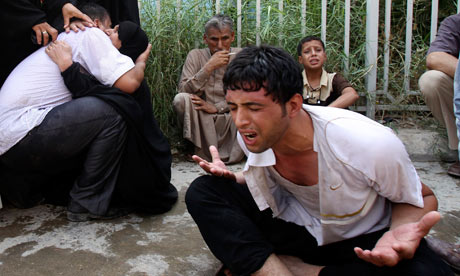
Residents mourn as they wait to claim bodies of bomb attack victims outside a morgue in Baghdad
Residents mourn as they wait outside a morgue to claim the bodies of victims of another bomb attack in Baghdad. Photograph: Saad Shalash/Reuters

As a proofreader in a news agency in Iraq's Kurdistan region I feel like a doctor, but the type of patients I indirectly meet every day are average Iraqis. Unlike a doctor I cannot cure their illnesses or prescribe medication but I have managed to identify the cause of their psychological illnesses.
Today, such Iraqis leave home unsure if they will return to their families that evening or not. Those who have jobs work long hours every day for little pay. If they are lucky their children or nephews and nieces are not yet kidnapped and if they are extremely lucky they haven't had more than one relative martyred in a suicide attack.
Report after report comes in and I begin to feel the woes and the pains of the Iraqi people. Their restlessness and how desperate they are to live a day without hearing a bomb, without being at risk of kidnapping and to have more than just a few hours of electricity every day.
These patients have wounded hearts, they have anger management problems, they have lost loved ones and their scars are yet to heal.
Recently the Iraqi interior ministry revealed that the country had itsdeadliest month for two years in July, with more than 1,500 casualties. Asingle suicide attack on an army recruitment centre in Baghdad last week killed 57 people and wounded 123.
Not a day passes behind my desk that I do not receive an article about a roadside bomb, a suicide attack or a killing. I retype the same words every day: "unidentified gunmen" killing a certain number of civilians and then "escaping to an unknown location".
It is hard to believe the country is floating on what the world refers to as black gold. The average Iraqi relies on food rations and is desperate for car fuel – that is, if he still has a car.
As a young girl when thinking of my future and ways to reach my dreams, my eyes begin to sparkle with hope. The average Iraqi's fills with tears as he or she tells you: "I just hope live tomorrow".
Recently it was revealed that narcotic drugs are being produced in certain areas such as the Dhi-Qar province. Radiation from war remnants has been found as the cause of cancer among young children in particular. Missiles were found in a girls' school in the Adhamiya area and numerous unidentified dead bodies are found almost every day.
I can only imagine Baghdad as being flooded with corpses and wounded people.
Politically, Iraq today is like a ship in the middle of the ocean with tens of captains, each stirring in a different direction towards their own interest.
As for the government, the electricity minister has resigned and the factions are yet to agree and form a government – five months after the election results. The reality is it is a fight over a seat – the prime minister's post; as citizens are crying for power, food and security, the government is busy searching for where its treasure lays.
Reports state more than a third of the new parliamentarians are supposedly on holiday.
Even if the government forms and with some miracle the requirements of the people are met, it will take an entire generation to heal the wounds of the average Iraqi. The psychological pains are greater than any physical wound.
Every Iraqi needs a psychologist or a doctor. The tragedy is that few worthy doctors are left in the country, as many were threatened and hadno alternative but to escape in fear of their lives.
After knowing the pains of the Iraqis it is frustrating as day after day I proof the same sentence in tens of articles, after so and so met "no agreement was reached". With a seat up for grabs that is worth more money and power than one can imagine, who cares about the average Iraqi
?

8/19/2010

Mission Accomplished 2 - Complaint To BBC


I submitted a formal complaint to the BBC today about remarks made by Evan Davis on the Today programme this morning on Radio 4. I expect to receive a response and will post it. Complaint below:

The comparison made by Evan Davis this morning on the Today programme of US forces in Iraq (departing) with the liberation forces in France was grotesque. At least, fortunately for the BBC, Hugh Sykes shot it to pieces on air. However, the comparison and remark was crass and tasteless in the light of the deaths of hundreds of thousands of Iraqis and the displacement of one and half million (conservative estimates in both cases). I will not be the only person to find the remark offensive and in bad taste, I believe.

Mission Accomplished - This Time It's Bullshit 2


Pulling all combat troops out of Iraq? 50,000 will remain there as 'advisers'. Yeah, right. Of course, all troops are trained for combat; calling them “non-combat support personnel” is simply B.S. Obama wants to campaign for Democrats in the mid-term elections by lying about ending combat in Iraq.
More absurdly, the Fox 'News' Channel interviewed an army officer this morning by first congratulating him and his fellow soldiers for “making Iraq a safe and secure place.” Before he said this, the network announced that they could not reveal the location of the interviewer “for security reasons.” The interview took place at a location where they were completely surroundedd by ten foot high piles of sandbags. This is how Fox and the war cheerleaders spell “secure.”

8/17/2010

Saddam and WMD - A Play in One Act


Dramatis Personae:-
George Bush - A doltish middle aged recovered alcoholic
Tony Blair - A sycophantic narcissist
Various other gullible or obsequious national leaders.


ACT 1, SCENE 1
Bush : Even if Saddam has no WMD the Iraqi army has devastating weapons systems, lethal.
Blair : How do you know?"
Bush : We looked at the receipts.

CURTAIN(S)

8/14/2010

360 Degree Rotational Fire

From OpEdNews.com, Ross Sherwood adds further details to the story of a battalion commander in Iraq who ordered his soldiers to engage in "360 degree rotational fire" upon being hit by an IED, and to shoot "every motherf*cker on the street," including women and children. Roy Corcoles recounts the training which reinforced the reaction to obey the order. You were asked, if you saw an attacker with many civilians close by and it was certain some would be killed or hurt, would you fire your weapon? The correct answer was "yes." But if you did not answer yes fast enough, you were beaten.
This is a continuation of the underside of war now being revealed by Wikileaks, and of the training which is systematic and routine in the Army. It is intended to make you do things that the ordinary person, still sensitized to other human beings, could not do. Specialist Corcoles told the reporters, when the IEDs hit and it came time to shoot "every motherfucker on the street" as the Commander had ordered, he purposely turned his gun away from people. "You don't even know if somebody's shooting at you. It's just insanity to just start shooting people," he said.
What these soldiers are describing, tit-for-tat retaliation against civilians, is a clear war crime which has been successfully prosecuted after WWII in the case of German SS Obersturmbannführer Herbert Kappler. In 1944 Kappler ordered the mass execution of civilians in the ratio of 10 to 1 for every German soldier killed in a March 1944 hidden bomb attack by Italian partisans. The executions took place in the caves of Ardeatine in Italy. You may have seen a movie about it starring Richard Burton.
This is different from the usual atrocities we hear about in Iraq as it was ordered at a high level by a battalion commander as a "Standard Operating Procedure" in a cold-blooded and deliberate manner, and the order was carried out many times. Attempts to get the attention of Congress on this have so far fallen on deaf ears.
After the war Kappler stood trial for war crimes and was sentenced to life in prison. This dishonors the Armed Services and our servicemen and women, who are bound to abide by behavior specified in the US Military Code of Justice, and not start to resemble Saddam Hussein, who ordered the killing of civilian Kurds in retaliation for attacks on his troops.

8/13/2010

As Obama Pretends To Withdraw - Some Benefits for Iraqis To Be Grateful For

Map showing electricity supply to regions of Iraq

I would say this speaks for itself. It is a significant dip in quality of life for most Iraqis even compared to Saddam's time. Of course it only applies to those who have survived the Saddam years and (god help us) 'Operation Iraqi Freedom'.

Death of Dr.David Kelly - Some Thoughts

David Kelly was one of the world's foremost experts on nuclear, chemical and biological weapons. He was also the main source for a claim by Andrew Gilligan, a BBC reporter, that Blair's government had rewritten publicly-released intelligence to make it "sexier", in the hope of justifying the invasion of Iraq in 2003. Following the Gilligan claim, Kelly was identified as the source of the leak. A few days after a stressful appearance before a Parliamentary committee investigating Mr Gilligan's allegations, he was found dead in the woods near his Oxfordshire home. The official account (given in the Hutton Report) was suicide.His death is in the news again after a group of doctors wrote to the Times newspaper, claiming that the suicide verdict is unsafe and demanding a proper inquest. That is only right and proper: this was a man, after all, who felt so hounded by his employer that he seemingly resorted to taking his own life.
There were a number of problems with this:
- there were no fingerprints on the knife used to cut Dr Kelly's wrist, for instance,
- Dr Kelly apparently suffered from an allergy to medicine that might have made swallowing the pills impossible.
Blair's apologists are out in force in the papers today trying to make the Times letter appear a conspiracy theory. They are saying that no British Prime Minister would sanction such a thing in any circumstances. That may or may not be true. But what about, for example, Blair's 'Friends of Israel' cronies who have a long form-sheet for this kind of thing. Israel had a vast vested interest in Saddam being brought down at any cost. They have resorted to assassination pre- and post- the death of Dr. Kelly. An inquiry would shed light into this very murky affair. Whatever would come out, that light will not shine favourably on Blair or his warmongering friends.

7/16/2010

Iraq Casualties - A State of Ignorance


A new report has been published on the pathetic efforts of the UK Government to keep a handle on the scale of civilian casualties and carnage in Iraq. Link to the full report here

7/15/2010

Iraq - Blair's Tunnel Vision


A few months later, in 2003, Mandelson challenged Blair on what would happen once Saddam Hussein had been overthrown. "You can go in there, you can take out Saddam, but what do you do with Iraq?" he asked Blair. "You're going to have a country on your hands. I don't know what your plan is. I don't know how you're going to do it. Who is going to run the place?"Blair replied: "That's the Americans' responsibility. It's down to the Americans''. Link

7/12/2010

The New Iraq - Thanks, America

COURTNEY E. MARTIN | July 12,
From American Prospect
When Nation-Building Becomes Cowardly Escape

Americans should be outraged that shoddy infrastructure and broken promises will be our legacy in Iraq. If you walk down Falluja's busiest streets, you are likely to travel parallel with open trenches that smell of putrid waste. These trenches, vestiges of a planned but unfinished sewage treatment system, are more than an eyesore and an assault on the olfactory senses. They are a reminder of America's broken promises in the ongoing nation-building effort in Iraq.The New York Times reported last week that many of the most fundamental needs of the Iraqi people, the most vital infrastructure projects, have been abandoned. Of the long-planned sewage system, for example, theTimes reports, "After more than six years of work, $104 million spent, and without having connected a single house, American reconstruction officials have decided to leave the troubled system only partly finished, infuriating many city residents." The project was initially supposed to treat waste for Falluja's entire population (200,000 people), with room to grow by 50 percent. Now it will, at best, serve 4,300, before the Americans working on the project leave town.Iraqi citizens shouldn't be the only ones infuriated by our military's half-assed effort to rebuild a nation that we so righteously destroyed not so long ago. Americans should also be outraged. We should be fuming. This war was fought in our names, and now shoddy infrastructure and broken promises will be our legacy. We should be calling our political representatives and demanding that the U.S. military finish what it started in Iraq and implement a long-term plan for incorporating nation-building practices effectively and ethically.The RAND Corporation reports, "Nation-building has been a controversial mission over the past decade, and the extent of this controversy has undoubtedly curtailed the investments needed to do these tasks better. So has institutional resistance in both the state and defense departments, neither of which regards nation-building among its core missions. As a result, successive administrations tend to treat each new such mission as if it were the first and, more importantly, the last." In other words, we reinvent the wheel (badly), following every new conflict. We can argue the morality of wars, but as long as we keep participating in them, we must be committed to leaving them with dignity and integrity.In a study of the seven historical attempts by the U.S. to nation-build -- in Germany, Japan, Somalia, Haiti, Bosnia, Kosovo, and Afghanistan -- RAND found that "there is no quick-fix" and that "none of our cases was successfully completed in less than seven years." It's worth remembering that we started the Iraq War before finishing the job in Afghanistan. Now we want to bail before the job's done in Iraq, too, setting ourselves up for another half-cooked polity and a continued world of hurt.The financial costs are high, indeed, but the costs in terms of security and morality are potentially even higher. Our nation-building blunders are not just ineffective and embarrassing; they're downright dangerous. Leaving a taste like this in Iraqis' parched mouths is certainly not going to make Americans any safer. The president of the Falluja City Council told The New York Times: "I told the Americans if they want to leave a good impression ? and to erase bad feelings about the United States from the war, they should finish this project completely and properly. It was supposed to be finished in two years, then five years, and it still isn't complete. There's been no benefit to us."Even many of the projects that do look to be on the path to completion are being finished so quickly and haphazardly that engineering standards have been thrown out the window. Shaymaa Mohammad Ameen, who works with reconstruction officials as a liaison for the Diyala Provincial Council, told the Times that "American officials frequently threatened to leave when Iraqis questioned engineering standards and brought up other safety issues."The U.S. is slipping out of Iraq, base by base, soldier by soldier, not with a bang but with a whimper of unfulfilled promises and blatant denials. Sure it would be nice to just come home, as so many on the left have argued. No one wants our troops in Iraq any longer than is necessary. But what's even worse than prolonging their presence is undermining their work thus far by asking them to leave a job shoddily and incompletely done. Our troops' integrity -- and that of the country -- is at stake.When asked about the abandoned projects and dwindling quality of those that haven't yet been scraped, Col. Dionysios Anninos, head of the Army Corps of Engineers, told theTimes: "I am not aware of the Iraqis having any sort of hard feelings that we will not finish current projects." Really? You break a promise to five-sixths of Falluja's population and no one seems perturbed? And then, as if to add insult to injury, he enthusiastically added, "We will finish strong!"This isn't nation-building; this is cowardly escape. The American public shouldn't stand for it. Additional research by Krystie Yandoli.

7/05/2010

Just Another Day In Iraq

He says he can pinpoint the root of his problems back to an incident in Basra in the first month of the Iraq invasion, seven years ago. "We were told to hit and clear an enemy building," says Dale. "The tanks opened up on the building and we went in, firing, throwing grenades in every room. We thought there was no one firing back because of the weight of fire. But when we got in there, it wasn't an enemy building, it was just a normal family. There were about seven of them in total. Dead children lying all over the floor." It was 27 March, 2003, his 33rd birthday.
As platoon sergeant he had to clear the casualties: "I really struggled hard with it. We were always told that we had to go in gently, not to injure any civilians. Me and the corporal got together afterwards and we knew what we'd done was wrong. But you tried not to talk about it."
My conclusion is that this victim of the Iraq debacle still doesn't understand his own part in it. Full story here.

7/04/2010

Blair 'Legacy' Crumbling By The Day


Poor old Tone. He is even execrated for winning awards as per my previous post and the chorus of derision in just about every Sunday newspaper in the UK yesterday. Now it emerges he is costing us taxpayers £250K a year for his personal security. I'll tell you what - he won't be very secure, 250K or not, if he ever comes along my street.

6/16/2010

Help For Heroes Appeal

Grown men aren't supposed to cry. But if you have been through all that Alastair has, going to hell and back, crying is impossible to avoid. Alastair still has flashbacks to the war in Iraq and how he helped start it. It was his job. He was good at it. He sat up all night copying things from the internet to warn the nation that they were going to be blown up in 45 minutes. Now he sits alone staring out of the window trying to make a new life for himself as a diarist. But the past keeps coming back to haunt him. Even on Sunday mornings when he is tirelessly plugging his books on TV AM, memories of his former life can overwhelm him and he loses control. He will blurt out things like ' I lost my best buddy in that war. I owed him everything. Tony was a great guy. We covered each other's backs.'

DONT FORGET ALASTAIR AND GIVE GENEROUSLY NOW.
Help For Heroes
PO BOX 2003
Fallujah Industrial Estate.

6/08/2010

Like To Buy a Murderous Gang of Mercenaries?

The security company formerly known as Blackwater is looking for new ownership, announcing Monday that it is pursuing a sale of the company that became famous for its involvement with the U.S. government in Iraq and elsewhere. The Moyock, N.C.-based company now called Xe Services announced its decision in a brief statement that gave few details.
"Xe's new management team has made significant changes and improvements to the company over the last 15 months, which have enabled the company to better serve the U.S. government and other customers, and will deliver additional value to a purchaser," the statement said.
Owner and founder Erik Prince said selling the company is a difficult decision, but constant criticism of Xe helped him make up his mind. "Performance doesn't matter in Washington, just politics," he said.
The private company became infamous as Blackwater, which provided guards and services to the U.S. government in Iraq, Afghanistan and elsewhere. It became one of the biggest defence contractors in the world, but it also attracted criticism over its role in those missions.
It has been trying to rehabilitate its image since a 2007 shooting incident in Baghdad that killed 17 people, outraged the Iraqi government and led to federal charges against several Blackwater guards. The accusations later were thrown out on a technicality after a judge found that prosecutors mishandled evidence. In March, Senate Armed Services Committee Chairman Carl Levin suggested the Pentagon should consider banning Xe from a $1 billion deal to train Afghan police. He said he thought the company's involvement was hindering the U.S. mission in Afghanistan. The announcement comes less than 3 months after Xe sold its aviation division for $200 million to AAR Corp in a bid to boost Xe's balance sheet.
More recently, five former executives, including Gary Jackson, the company's ex-president, were indicted on charges of conspiring to violate US firearms laws. Jackson was among the top officials who left the company last year.